“The End is Near”

The hardest part of choosing which cartoon to post here was wading through the thousands of similar images. It’s unbelievable how many are addressing this concern, attempting humor about it. Seeking the funniest, I figured Homer was a good bet.
What They Really Mean by “Intelligence”
There’s really nothing artificial about the “intelligence” (AI) that comes out of the large language models (LLM), the humongous databases that power AI.
Think of all the spy movies you’ve ever watched, or governmental procedural dramas. They often speak of gathering “intelligence” about an enemy, a location, or an operation. They’re simply replacing the word “information” with “intelligence.” That is the real extent of the intelligence you can expect from artificial intelligence.
They’re not smart. In fact, they’re not thinking at all. Computers don’t think. They process.
They Process What??
AI has a tremendous volume of data available to it, and it can find things in that huge database very, very quickly. It can then produce summaries of the information, pick out things you most want to know from the information, and even compose new documents based on what it finds.
Ultimately, that’s all they do. They may seem like they’re people when they communicate with you, but that’s just mimicry they’re very good at.
Training AI
When you hear people say they’re “training” the LLM, they are using advanced processes to introduce huge volumes of data into them. Enormous amounts of data about literally everything.
When you type a question or a request into the AI “chat” window, you are using what they call a “harness” which provides you with a connection to that LLM along with all the tools and resources it may need to use to help you. What has really been improving dramatically lately have been the harnesses. The LLMs just get bigger. But more and more capability is being built into the harnesses all the time. Each LLM comes with a devoted harness. There are others, like Claude Code, Codex, Cursor, LangGraph, CrewAI, OpenCode, Antigravity, Perplexity, and others.
What’s really interesting is that most of these alternative harnesses are designed to help you create your own software! And none of them are designed for professional developers. The whole idea of them is that you get to tell them what you want the software to do and it builds software to do it. If it doesn’t exactly match what you had in mind, you talk about it until it gets it right. Literally anybody can get some value out of whatever harness they choose, but you don’t really need to choose one if you’re just doing “normal stuff” with AI.
What Means “Normal Stuff”?
It may help to think of AI as having four “levels” for you.
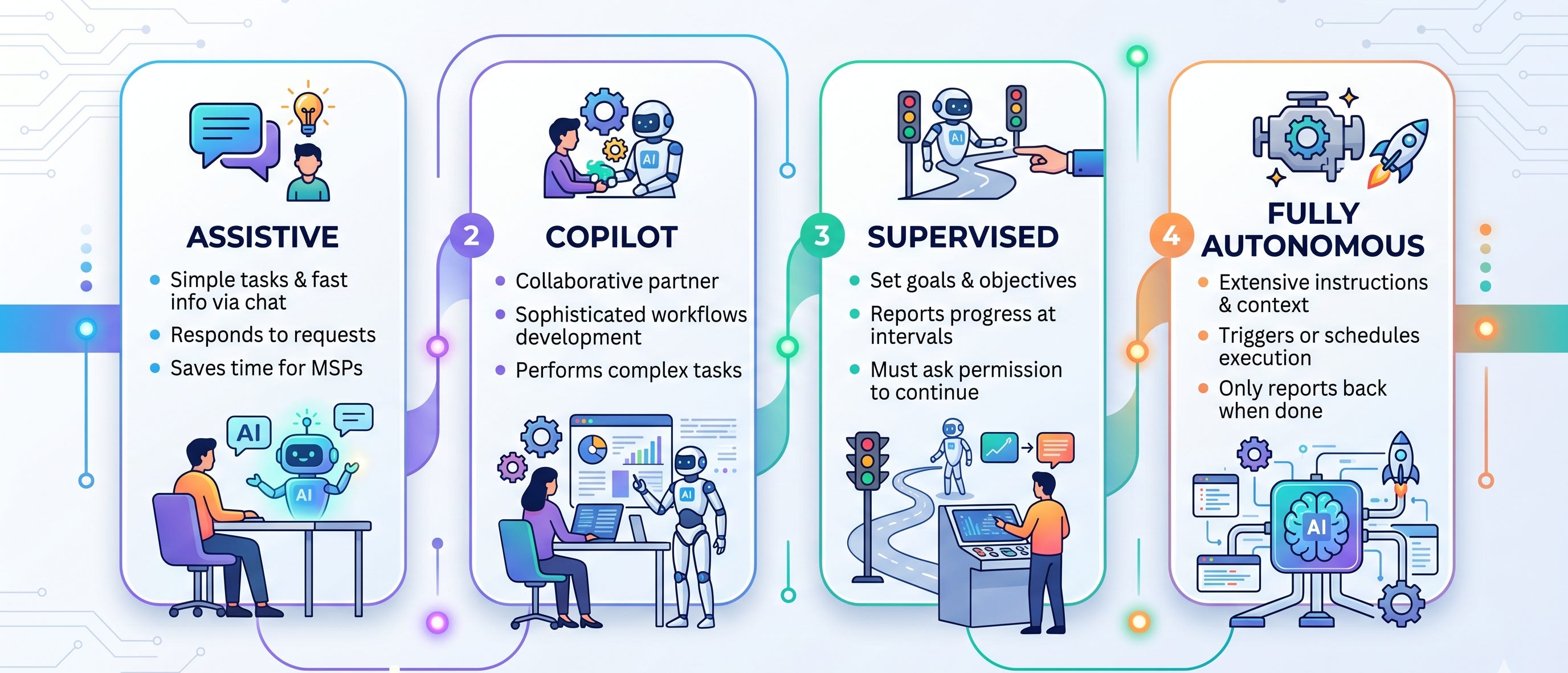
Assistive (or Generative)
You ask a question and get an answer, usually a more complete answer than search engines used to give you. You ask for something to be created, like a picture, or a song, or a letter, a report, or many other things, things you use all the time. The AI creates it for you. You want to go shopping and find a particular product, or go out to dinner, or find a recipe, or plan a vacation. You can ask the AI to assist you with any of these and much more.
Collaborative (or Copilot)
Soon, you realize you can work together with the AI to build more involved things that need more input from you. Often, you don’t even realize it but you start to partner with the AI, collaborating on all kinds of projects. This was the limited vision Microsoft brought to market which contributed to them missing it completely and playing a desperate game of catch-up now. That’s why they called it Copilot.
One thing about collaborating with your AI, you learn a lot. It will come up with ways of doing things you hadn’t thought of and show you how they’re done.
Agentic (Supervised)
To give credit where it’s due, Microsoft CEO Satya Nadella really introduced us to “Agentic AI”. This is also simple to understand when you think about it. You explain to your AI LLM how to do something that’s pretty involved. You explain everything about it. Why it’s being done, what environment its being done in and done for, what limitations there are, where the resources are, and what a successful outcome looks like. This almost completely duplicates how Ken Blanchard and Spencer Johnson define management of people in their popular book, “The One Minute Manager.”
The key thing is that the AI checks back with you on a regular basis all along the way to confirm that its proceeding correctly. You always have opportunity to correct it. And, again, there’s no “computer programming” involved. You just discuss it.
Agentic (Fully Autonomous)
Be afraid. Be very afraid!!
Okay, this is where everybody’s concerns begin. Similar to supervised agentic AI you describe in great detail how to do something complicated. The difference is that here you just set the agent off on its own to do what it’s supposed to do. The only time you hear back from it is when it’s finished. There’s no “in-process” supervision.
Your imagination runs wild. You see the AI agent going way off the reservation and doing all kinds of awful things. The most vivid model we all seem to know well is Judgment Day in The Terminator movies, the day when SkyNet “becomes aware.” It’s been trained to protect the Earth no matter what. It then decides that the greatest threat to the safety of the Earth is human beings, so they all need to be eliminated.
Given the current state of the world, argument could be made that SkyNet was kinda right. The policy Henry Kissinger gave us to protect us all from nuclear Armageddon is called “Mutually Assured Destruction” and, yes, the acronym is incredibly appropriately “MAD.” The world is doubtlessly MAD.
The thing is that very few viable use cases have been found for fully autonomous AI agents. Nobody can come up with reasons to create them. So only a fraction of the AI agents being developed are fully autonomous. A tiny fraction.
So, What Do YOU Want from Artificial Intelligence?
Every time I can’t remember something, I instantly turn to my favorite AI and ask. It knows. It always knows. Whenever I’m looking for something, I ask my AI to find it. A good example is files on my computer. I often want to refer back to things I wrote years ago when writing something new. I just never remember when I wrote it, who I wrote it for, what I called it, or anything else about it other than something I said in it.
Every time I’ve asked my AI to find those files, giving it only that fragment of a thought I do remember, it finds it. It finds it fast.
My research time has been chopped to ribbons. I don’t go hunting for websites with the information I need. My AI does in a minute what took me days.
My Bodacious Statement
We often refer to them as AI assistants, and that’s the foundational model I described earlier. I’d be willing to bet that more than 90% of people never do more with AI than what they can accomplish at the assistive level. That’s usually all you need.
So here, in one sentence, is how to figure out what you want from artificial intelligence:
Figure out what you want to do or know, and ask.
Nuclear physicists, biologists, and other scientists are asking extraordinarily complex questions and getting amazing answers that move their research forward in proverbial leaps and bounds.
Imagine what AI can do with the recipe you’re looking for, or the letter you need written.
My Other Bodacious Statement
…and I feel totally comfortable saying it.
AI will never wipe out the human race or do anything else destructive. I say this because AI is not capable of taking the initiative.
People using AI may harm or destroy things. AI accelerates and amplifies your ability to get stuff done. If what you want to get done is typical, normal, everyday stuff, GREAT!!
If, on the other hand, you want to create havoc, AI will make it much easier and faster. The danger here is no different from the insanity that results in there being more guns in the United States than there are people. AI on its own can be trusted. But put it in the hands of certain people…
Another Cartoon
That last paragraph about insanity and evil intent motivated me to seek another “end-of-the-world-is-near” cartoon. It was actually a whole lot easier to find the LEAST funny end-of-the-world-is-near cartoon: